


A relaxing massage is the most requested manual treatment and also the least well understood. People tend to assume it is just a gentler massage, when in fact it has a different purpose: it does not set out to fix an injury or break down a specific knot, but to lower your general muscle tone and bring down the level of activation of your nervous system.
That difference in purpose determines everything else: the techniques, the pace, the pressure and the length of the session. A well-executed relaxing massage is not a softened deep tissue massage but a technique with its own criteria.
Here we explain what it involves, what you will feel, how the session unfolds, which length suits you and how it differs from deep tissue and therapeutic massage.
What does a relaxing massage involve?
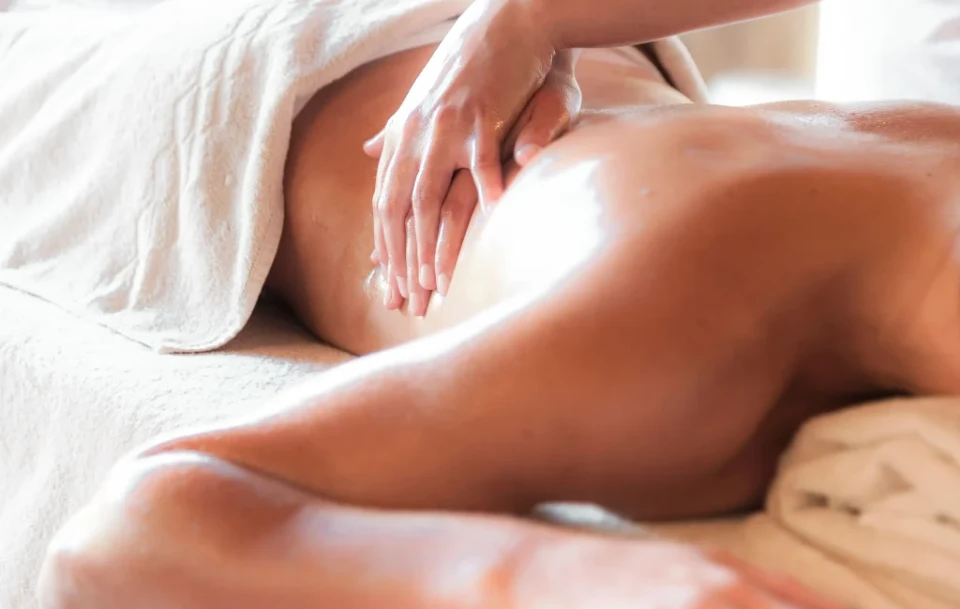
A relaxing massage is manual bodywork based on gentle, slow, evenly paced techniques applied mainly to the superficial muscles. Long gliding strokes, superficial kneading and sustained low-intensity pressure over the tightest points predominate.
The rationale is physiological. A gentle, sustained and predictable touch activates mechanoreceptors in the skin that help reduce sympathetic nervous system activity. What you notice is your breathing slowing down, your baseline muscle tone dropping and areas releasing that you rarely identify as tense, such as the jaw or the shoulder girdle.
The session moves methodically through the back, neck, shoulders, arms and legs and, if there is time, the feet, hands and scalp too. Pressure stays within a comfortable threshold throughout: a relaxing massage should never hurt. If it does, your body guards and cancels out precisely the effect you came for.
How to choose the length: 30, 60 or 90 minutes
Duration is not a question of quantity but of scope: it decides how many regions we can cover and how much time is left for the final relaxation phase, which is what consolidates the effect. This is the criterion we use to advise you.
Choose 30 minutes if your tension is localised and your time is short
That is usually the case when the cause is postural — neck, shoulders and upper back — or when you have been on your feet for hours and it is your legs that feel heavy. It does not allow a full-body route, but it does leave the worst area properly worked.
Choose 60 minutes if you want a complete full-body treatment
It is the length that best balances scope and depth, and the one we recommend if this is your first time: there is time to cover every region unhurriedly, including the ones that go unnoticed and hold residual tension.
Choose 90 minutes if you are after deep relaxation
On top of the full route there is time for feet, hands and scalp — areas with a high density of nerve endings that respond very well — and for extending the final phase. It is the option after a long stretch of sustained load, or when you want the whole experience without watching the clock.
You can see the three options and book directly on our services page.
Benefits of a relaxing massage
The benefits show up on the physical and the emotional level at the same time.
Relief of tension and stress. Tension of emotional origin distributes itself in a fairly consistent pattern: upper trapezius, neck, jaw and lower back. Sustained manual work on those areas interrupts the cycle of held contraction, and that drop in tone usually comes with less of a sense of mental overload.
Better circulation. Rhythmic stimulation of the muscles encourages blood flow to the tissues treated, improves the delivery of oxygen and nutrients and helps venous return, which is especially noticeable in the legs.
Less tiredness. Holding permanently elevated muscle tone is a continuous energy cost you are not aware of. Reducing that baseline contraction removes the cost, and the sense of tiredness drops appreciably over the following days.
Better rest. This is one of the effects clients mention most, and the evidence points the same way — though it is worth reading carefully. A meta-analysis published in 2023 in the Journal of Clinical Nursing (Fang CS et al., 32(15-16):4362-4373) reviewed ten randomised controlled trials, eight of which entered the meta-analysis, and found an improvement in subjective sleep quality. With two important caveats: the population studied were patients in critical care, and the authors themselves rate the quality of the evidence as low. Applied to a healthy person the mechanism is plausible — reaching the end of the day with less muscle tone and less activation makes falling asleep easier — but that is not the same as saying massage cures insomnia.
Additional benefits for body and mind
Alongside the main effects there are two areas worth mentioning, and mentioning honestly.
On the emotional level, it is useful support during periods of anxiety or mental overload. Sustained touch, slower breathing and giving yourself dedicated time have a regulating effect that goes beyond the muscular. It does not replace professional treatment where that is needed, but it is a reasonable complement within a care routine.
On the aesthetic level, many people leave with skin that looks more hydrated and luminous, thanks to the combination of oils and circulatory stimulation. It is a pleasant and short-lived effect: a relaxing massage is not a cosmetic treatment and does not replace one.
How is a relaxing massage performed?
Knowing the techniques helps you understand why it works.
The foundation is gentle, repetitive movement. Long gliding strokes travel the whole length of the muscle and prepare the tissue. Superficial kneading mobilises it without compressing it. And sustained low-intensity pressure is applied where tension gathers, held for as long as the tissue needs to release on its own. The effectiveness comes from the consistency of the stimulus, not its intensity.
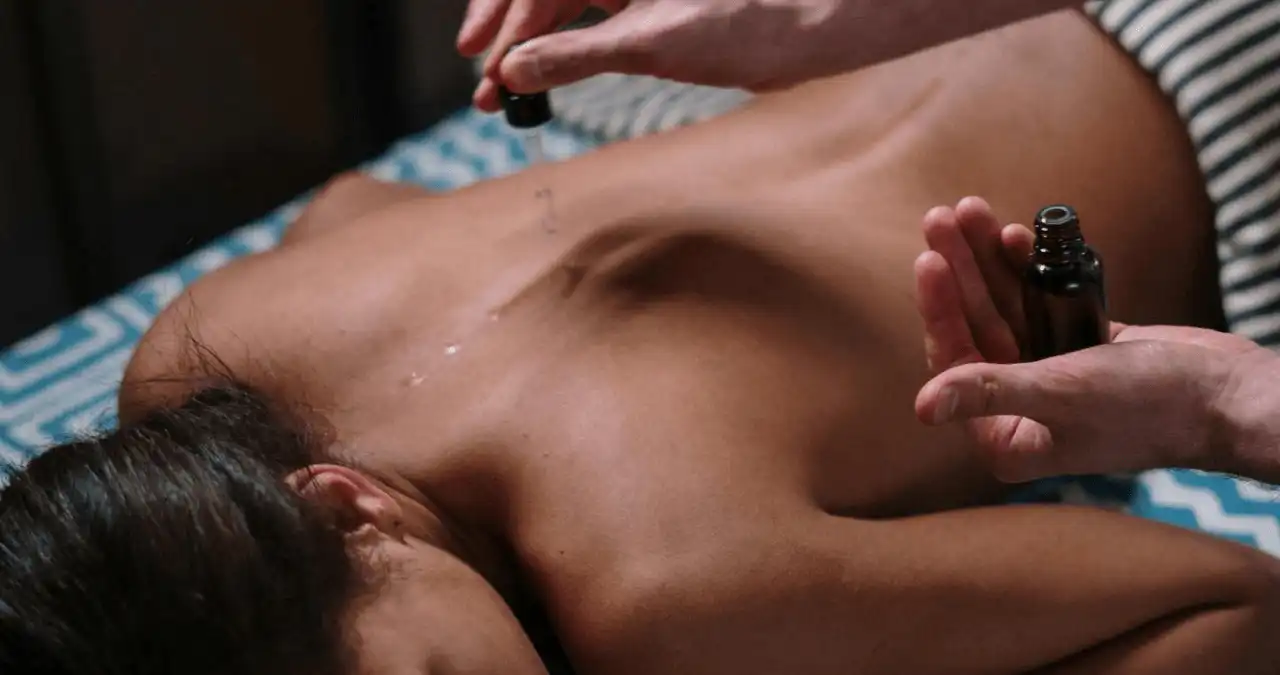
We use essential oils, which reduce friction and allow continuous gliding without pulling on the skin. The aromatic component reinforces the effect: lavender if you want something sedative, citrus for a less soporific relaxation, eucalyptus if you feel congested. We choose it with you before we start.
We also work in gentle stretching and circular movements: passive mobilisations of the shoulder, neck and hip, and circular work over the joints. These release restrictions that strictly muscular work cannot reach.
And one factor shapes the result as much as the technique does: the setting. Soft indirect lighting, low music, a warm room and no noise or interruptions. A technically flawless treatment in a cold or noisy room does not relax anyone, because your nervous system does not lower its guard somewhere it reads as unsafe.
What to expect from your session at Beganur Massages
The session starts before the table. We spend a few minutes talking with you and gathering what we need: where it bothers you most, which areas you would rather we avoided, what pressure feels comfortable, whether you have had manual treatment before and any relevant health condition.
That is what lets us personalise the session. Two people booking the same length do not get the same treatment, because they do not have the same distribution of tension or the same tolerance to pressure.
We work with a single therapist, Mario, a sports massage therapist and manual therapist specialised in deep tissue and sports massage, so the person who assesses you is the person who treats you. The studio is at Praza da Nosa Señora da Mercé de Conxo, in a quiet area about twenty minutes on foot from the old town, with no street noise during the session. You can find directions on our contact page.
During the treatment we adjust the pressure continuously according to how the tissue responds. You can ask for more or less intensity at any point. At the end we leave you a short transition period before you get up, and we recommend hydrating and avoiding demanding activity for the next few hours.
If this is your first time, here is how to prepare for your first massage.
Who is a stress relief massage for?
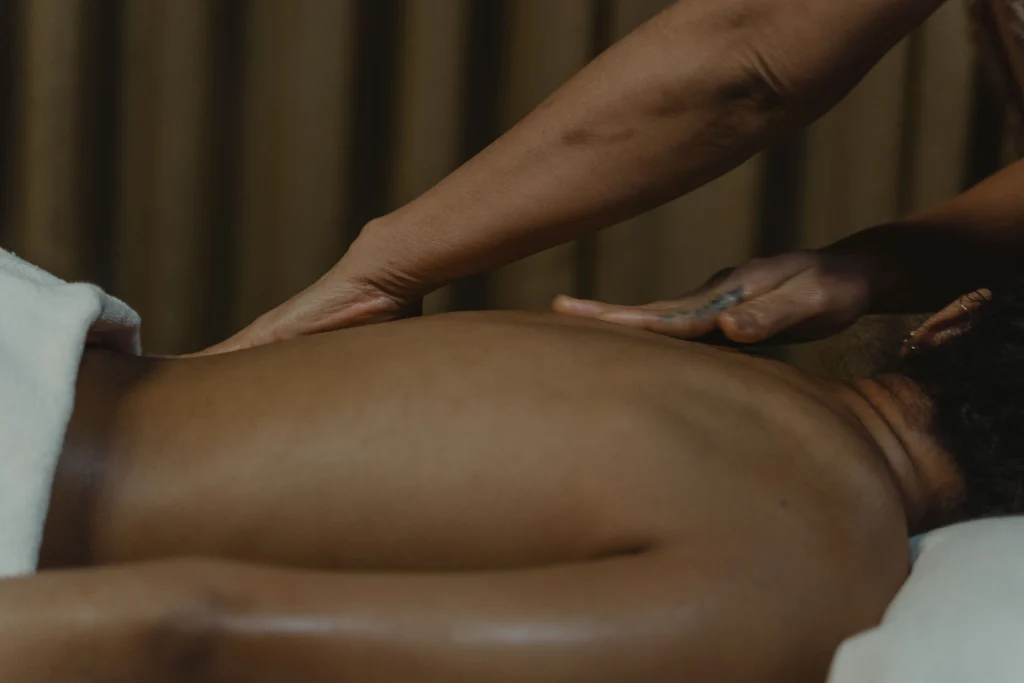
A stress relief massage suits most adults without specific contraindications. There are a few profiles it fits particularly well.
If you are carrying stress, fatigue or muscular tension, especially if you spend long days in the same posture or are going through a period of high mental load.
If you are after general wellbeing, with no muscular pathology involved, and want to build it into a regular care routine as prevention.
If you want to take the edge off anxiety or find some calm during a period of change or pressure.
If you struggle to rest and physical tension is part of the problem.
And if you have just finished the Camino de Santiago, what you probably need is not this massage but one adapted to that specific effort: we cover it in pilgrim massage in Santiago de Compostela.
The difference between relaxing, deep tissue and therapeutic massage
Telling them apart stops you booking a treatment that is not the one you need.
Compared with deep tissue massage. Deep tissue applies strong pressure to an already identified knot, to change the state of that band of tissue. It can be uncomfortable while it is being applied, and some residual tenderness in the next twenty-four to forty-eight hours is normal. A relaxing massage works at the surface, with low pressure and a complete route, and aims to bring down general tone. We cover it in benefits of tension relief massage.
Compared with therapeutic or sports massage. Therapeutic massage starts from an initial assessment and targets a specific dysfunction: persistent pain, limited mobility or functional impairment. It is directed work with a defined objective. A relaxing massage does not treat pathology: it prevents, relieves and accompanies.
The rule of thumb is simple: where there is pain or loss of function, assessment and therapeutic or deep tissue treatment; where there is tension, fatigue or stress, a relaxing massage. If your case is a bit of both, tell us when you book and we will adapt the session. You can compare all the options on the services page.
Frequently asked questions about relaxing massage
How long does a relaxing massage last?
We work with sessions of 30, 60 and 90 minutes. Thirty for localised tension, sixty for a complete full-body treatment and ninety for deep relaxation with detailed work on feet, hands and scalp.
Does a relaxing massage hurt?
No. That is one of its defining characteristics: pressure always stays within a comfortable threshold. If it hurts, the body guards and the effect you came for is cancelled out. You can ask for more or less intensity at any point in the session.
Do I have to undress?
Only as much as is needed to reach the areas being worked on. Regions that are not being treated stay covered with a towel throughout, and if you would rather we avoided an area, just tell us before we start.
How often should I have one?
It depends on your load. As a guide, once a month maintains the effect in normal periods, and every two or three weeks during stretches of high tension. Building it in regularly, rather than only when discomfort appears, works better than an isolated session.
Can I give a relaxing massage as a gift?
Yes. You can buy a gift voucher from our booking page and choose the length you prefer. It is a common choice for birthdays and for anyone stuck for a present.
Is it the same as a stress relief massage?
Yes, it is the same treatment. Stress relief massage is the name used when the reason for booking is mental load rather than muscular tension, but the technique and the criteria are identical.
Book your relaxing massage in Santiago de Compostela
A relaxing massage is a manual treatment based on gentle, evenly paced techniques, aimed at reducing muscle tone, lowering activation and improving the quality of your rest. Its effects on circulation, on the perception of fatigue and on emotional wellbeing are noticeable from the first session.
Building it in regularly, rather than only when discomfort shows up, is the most effective way to stop accumulated tension from turning into a problem.
At Beganur Massages, in Santiago de Compostela, we work with 30-minute sessions for localised tension, 60 minutes for a complete full-body treatment and 90 minutes for deep, personalised relaxation.
Book your relaxing massage online or message us on WhatsApp at +34 697 310 146 telling us what you are looking for, and we will help you choose the right session.