


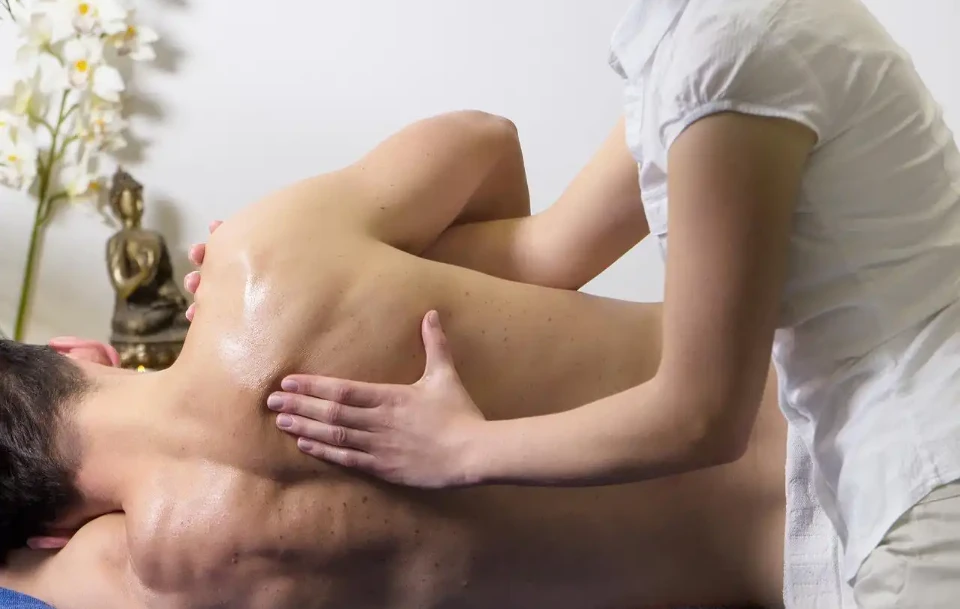
A therapeutic massage is a manual treatment aimed at a specific objective: relieving your muscular pain, giving you back the mobility you have lost and treating muscular dysfunctions identified in a prior assessment. It differs from a relaxing massage, which seeks general wellbeing and lower tone, and from a deep tissue massage, which focuses on one localised knot.
The distinction is not about naming. It determines how the session is set up: there is a prior examination, a defined objective, a choice of technique based on that objective, and an evaluation of the outcome.
Here we explain what it involves, what it is indicated for, which techniques are used, how it adapts to your case and when it is worth booking one.
What does a therapeutic massage involve?
It means applying specific manual techniques, consciously chosen and adapted to an area that has been assessed beforehand, in order to change the state of the tissue and restore its function.
That adaptation is what matters. Before we touch you we gather information: exactly where it hurts, how long it has been there, which movements make it worse or better, whether it radiates into your arm or leg, how you are sleeping and what you do for work or sport. That is what defines the technique, the depth and the application time.
The aim is to improve whatever brought you in. Sometimes that calls for deep pressure; other times for very delicate work on irritated tissue. Intensity is not a mark of quality: it is a variable dosed according to how the tissue responds and how much you tolerate.
One point on scope. Therapeutic massage is a manual therapy technique within the field of wellbeing and muscular recovery. It does not diagnose and it does not replace medical assessment or prescribed physiotherapy: it accompanies them. A competent professional knows where their scope ends and refers on when a case exceeds it.
What is a therapeutic massage for?
There are four main purposes, and they almost always come combined.
- Relieving muscular pain. Manual work on the affected muscle reduces the tension that keeps the discomfort going, and with it the perception of pain drops.
- Reducing knots and contractures. A contracture is a band of muscle stuck in involuntary, sustained contraction. Specific work on that band helps return it to its normal state.
- Improving mobility. Many movement limits do not come from the joint but from the shortened muscle around it. Releasing that tension usually restores a noticeable amount of range.
- Supporting muscular recovery. After hard effort, training overload or a stretch of high activity, it speeds up the tissue’s return to working condition.
There is solid evidence for the technique, and it is worth telling in full. The systematic review by Furlan and colleagues, carried out within the Cochrane Back Review Group and published in Spine in 2009 (34(16):1669-84), concluded that in non-specific low back pain massage was superior to inert therapy for both pain and function, and superior also to joint mobilisation, relaxation therapy and self-care education. The authors add two caveats: the benefit shows up mainly in subacute and chronic presentations and especially when massage is combined with exercise and education, and eight of the thirteen trials reviewed carried a high risk of bias. That first caveat supports exactly what you will read further down: manual treatment relieves, but if the cause is postural the posture has to change too. You can read the full study on PubMed.
What all these purposes have in common is treatment adapted to your particular complaint. Two people reporting back pain may need completely different sessions: lumbar overload from lifting and thoracic tension from sustained posture share a symptom, but neither the cause nor the approach.
Benefits of therapeutic massage for muscular and joint pain
These are the cases where the technique is most useful.

Neck massage: neck pain and tension headaches
This is the most frequent reason people come in, and not by chance: the neck carries postural load all day long. Neck pain usually comes with limited rotation — you struggle to look over your shoulder when reversing the car — and sometimes with a tension headache, the kind that presses from the base of the skull towards the forehead. Neck massage works the upper trapezius, levator scapulae and suboccipital muscles.
Lower back massage: pain in the lumbar area
Low back pain typically shows up when you stand after sitting for a while, or after hours on your feet. Lower back massage combines work on the paraspinal muscles and the quadratus lumborum with release of the hip, which is almost always involved even when it does not hurt.
Muscular overload
This happens when you ask a muscle group for more than it can repeatedly sustain. There is no structural injury, but there is a saturated muscle that hurts and performs worse.
Joint stiffness
That need to move a joint for a few minutes before it works normally. Where the origin lies in the muscle and the connective tissue around it, manual therapy produces a noticeable improvement.
Discomfort from sustained posture or desk work
This is today’s most common reason for booking. Long hours seated, shoulders rolled forward and neck pushed towards the screen, make the muscles adapt to that position until it starts to hurt. Treatment relieves it, but — as the Furlan review said — it works far better alongside changes in posture and some exercise. Here are five simple stretches you can do without equipment.
The most commonly used therapeutic massage techniques
There is no single technique, but a set of tools chosen according to the objective.
Controlled deep pressure. Sustained, progressive pressure over specific points of tension until the tissue responds. The key word is controlled: pressure is graded to the muscle’s reaction and to your tolerance, and never forced against pain.
Gentle mobilisations. Passive, short-range movements of the joint involved, to restore range without you having to do the work. They are particularly useful at the shoulder, neck and hip.
Release of tension zones. Specific work on the bands of tissue holding the restriction, with sustained techniques that allow a progressive release. It is slow and the relief is very noticeable.
To these we add deep kneading, cross-fibre friction and assisted stretching at the end of the session, which consolidate the work done. The exact combination is decided during the session itself, according to how the tissue responds.
Types of therapeutic massage by need
The treatment adapts to the person and the case. In practice it falls into three approaches.
For contractures. Where there are one or more localised, identifiable knots. It includes an initial tissue-preparation phase, intense local work on the affected bands and stretching afterwards. It usually resolves within a few sessions.
For chronic pain. Where the problem has been established for months, the strategy changes completely: lower-intensity sessions, more widely spaced, aiming at progressive improvement. Applying intense work to a chronic presentation tends to backfire and increase sensitisation.
For muscular recovery. Aimed at active people and athletes. Release and drainage techniques predominate over localised deep work, to speed the tissue’s return to working condition.
In all three there is one non-negotiable first step: the initial assessment. Without understanding what is happening and why, choosing a technique is guesswork. The minutes spent examining determine how effective everything after them will be.
Differences between therapeutic, relaxing and deep tissue massage
Comparing them by objective, intensity and expected outcome clears things up.
Therapeutic versus relaxing. The relaxing massage aims at general wellbeing and lower tone; the therapeutic one at treating a specific complaint. The relaxing massage’s intensity is low and constant; the therapeutic one’s is variable and adapted, with phases of deep pressure. You leave a relaxing massage calm and light; you leave a therapeutic one with less pain and more movement. We cover it in what is a relaxing massage.
Therapeutic versus deep tissue. Deep tissue is work focused on resolving an already identified knot, usually in one region and within one or two sessions. Therapeutic massage is broader: it can include that work, but it starts from a global assessment, takes the cause into account and is often planned across several sessions. We cover it in benefits of tension relief massage.
The practical rule: if what you need is to switch off, a relaxing massage; if you have one well-defined point, deep tissue; if the pain keeps coming back, you have lost movement or the discomfort returns again and again, therapeutic massage. If you are not sure, tell us and we will decide after assessing you.
Who is therapeutic massage for?
If you have recurring muscular pain. Presentations that alternate improvement and relapse over months. The objective is not just to relieve you but to break that cycle.
If your tension comes from work or posture. Long hours seated, driving or in sustained positions. Sustained postural load shows up almost always in the same area.
If you are an athlete or an active person. Runners, cyclists, people who train with weights or walk long distances. The technique helps both with recovery after effort and with preventing overloads that, untreated, can end in injury. If you have just finished the Camino, here is the specific treatment for pilgrims.
When is it worth booking?
Three common signals not to let slide.
Persistent pain. Discomfort lasting more than a few days that does not ease with rest. Intensity is not the criterion: mild pain that will not go deserves the same attention as sharp pain.
A feeling of stiffness. The area feels seized up, you need to move for a while before it works normally, or you wake up stiffer than usual.
Loss of movement. A limit appears in movements that used to be automatic: turning your head, lifting your arm or bending forward.
The most important advice is not to wait for the pain to get bad. Mild discomfort treated early usually resolves in one or two sessions; the same thing left for months becomes an established pattern that needs a much longer course.
Therapeutic massage in Santiago de Compostela: how to choose a massage therapist
If you are looking for a massage therapist in Santiago de Compostela for a therapeutic massage, the deciding factor is the training of the person who will treat you.
Incorrect application is not merely useless: it can make things worse. Excessive pressure on inflamed tissue, insisting on a point that will not take it, or applying a standard protocol without assessing first are mistakes with consequences. Accredited training and real experience in manual therapy are the difference between a useful session and a counterproductive one.
Three questions you can ask before booking anywhere: what training does the person treating me have, is an initial assessment included in the session, and what do you do if the case is beyond your scope. If all three answers are clear, that is a good sign.
At Beganur Massages we work with a single therapist, Mario, a sports massage therapist and manual therapist specialised in deep tissue and sports massage, so the assessment and the follow-up are always done by the same person: across a course of several sessions that means continuity, because nobody has to start again with you from scratch.
We apply therapeutic massage adapted to each case, with no predefined protocols, in sessions of 30, 60 and 90 minutes, with the option of adding a parafango application beforehand that prepares the tissue and makes the deep work easier to take. We are at Praza da Nosa Señora da Mercé de Conxo, about twenty minutes on foot from the old town; you will find directions on the contact page.
What to expect from your session
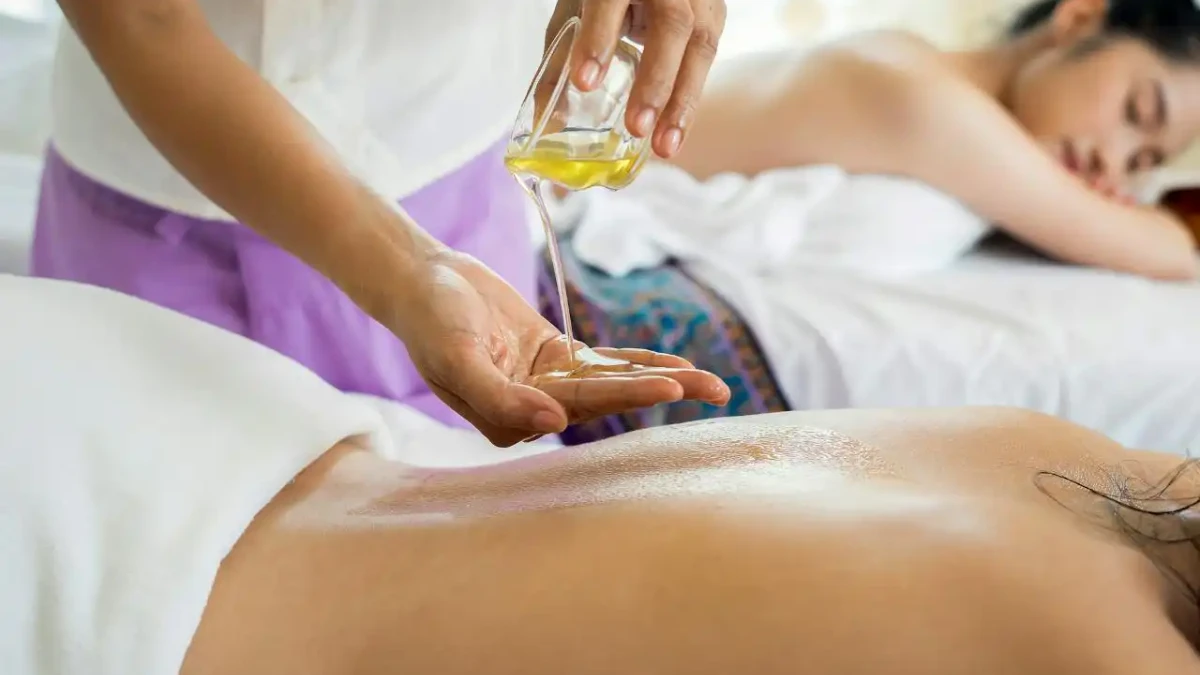
Initial assessment. The first minutes are questions and examination: what the pain is like, how long it has been there, what makes it worse and what helps, plus a look at the area and at a few movements. The session plan is built on that.
Adapting the treatment. We work with the technique and depth the tissue allows at that moment, adjusting as we go. We tell you what we are doing and why, and you can change the intensity whenever you want.
How you will feel afterwards. Usually you leave with a clear sense of relief and more freedom of movement. It is also normal to feel some tenderness over the next twenty-four to forty-eight hours where deep work was done; that is not a bad sign, it is the tissue responding. From there the improvement tends to build.
We recommend drinking water, avoiding hard effort for the rest of the day and keeping the area gently moving. If this is your first session, here is how to prepare for your first massage.
Frequently asked questions about therapeutic massage
Does a therapeutic massage hurt?
It should never be unbearable. Working on contracted areas can produce an intense sensation many people describe as discomfort that relieves; that response is normal. What is not normal is sharp or stabbing pain that makes you hold your breath. If that happens, say so there and then and the pressure is adjusted. Talking during the session is part of the technique, not a courtesy.
How many sessions will I need?
It depends on the case, and be wary of any number given before an assessment. As a guide: recent, localised discomfort usually improves a lot in one or two sessions; tension established over weeks or months may need three to five spaced sessions; and in chronic cases the usual approach is maintenance every three or four weeks. After the first session there is enough information to give you a reliable estimate.
Can I come with an already diagnosed injury?
It depends on the injury and what stage it is at. If you have a diagnosis and treatment under way, check with the healthcare professional looking after you first: in many cases therapeutic massage fits well as a complement, and in others it has to wait. Call or message us with what you have been told and we will advise you with no obligation. What we will not do is treat you blind or contradict a medical instruction.
How is it different from seeing a physiotherapist?
They are different things and they do not compete. Physiotherapy is a regulated healthcare profession: it diagnoses, treats pathology and can prescribe treatment. Therapeutic massage is manual therapy within the field of wellbeing and muscular recovery: it does not diagnose and does not replace physiotherapy, it accompanies it. If yours is muscular discomfort from load or posture, this is the right place; if there is a pathology or an injury to treat, the starting point is clinical.
Is it compatible with other treatments?
Generally yes, and it usually goes well alongside physiotherapy, therapeutic exercise or supervised physical activity. We need you to tell us about any treatment under way and any relevant medical conditions so we can adapt the session.
How long is the session?
We work with 30, 60 and 90 minutes. For a therapeutic massage 60 minutes is the usual choice, because the first minutes go on assessment; 30 is kept for a very specific area already assessed in a previous session, and 90 for cases with several regions involved or when parafango is added.
Book your therapeutic massage in Santiago de Compostela
A therapeutic massage is a specific manual treatment, applied after a prior assessment, indicated for relieving muscular pain, reducing contractures, improving mobility and supporting recovery. It differs from a relaxing massage in objective, intensity and outcome, and from deep tissue in the breadth of its approach.
It is a good option if you have pain, stiffness or restricted movement, and a better one still when those signals are mild, because that is when they are easiest to reverse.
If you have discomfort and are not sure which treatment you need, message us and we will assess it with no obligation. At Beganur Massages we advise you on the right type of session before you book anything. You can see lengths and availability on the services page, book online or message us on WhatsApp telling us what is going on.